Why Concrete Cracks in Palm Beach County
What Concrete Cracks Can Reveal About Movement, Drainage & Support
Concrete can crack for many different reasons, and visible cracking does not always mean the same thing. Some cracks develop as concrete loses moisture and changes volume, while others may be associated with settlement, restrained movement, drainage, loss of support, joint placement, loads, or conditions around the surrounding property.
The useful question is not simply whether a crack exists. Its location, pattern, whether the surface has moved, whether water collects nearby, the condition of adjoining concrete, previous repairs, and how the area is used can all help clarify what may be happening.
Palm Beach Concrete helps route cracked or damaged concrete project requests to independent local concrete contractors or service providers who may review the affected surface, visible cracking, movement, drainage, surrounding conditions, and project goals before discussing available options and next steps.
Request an Estimate
If cracking, settlement, uneven concrete, surface deterioration, or recurring damage is affecting a driveway, patio, walkway, slab, or other exterior concrete area, providing photos and project details can help support a more useful review.
Include the approximate affected area, how long the condition has been noticeable, whether it appears to be changing, any standing-water or drainage concerns, previous repair history, and how the surface is used.
Have photos, drawings, or project notes? You can attach them through the form or send additional details to
We will get back to you as soon as possible.
Please try again later.
Why Does Concrete Crack?
Concrete is strong in compression but can develop cracks when shrinkage, movement, restraint, settlement, support conditions, temperature changes, or applied loads create stresses the material cannot accommodate without separating.
Different causes can also occur together, which is why the surrounding surface and property conditions matter as much as the visible crack.
Plastic Shrinkage & Early-Age Moisture Loss
Plastic shrinkage cracking can develop while newly placed concrete is still fresh. If moisture leaves the exposed surface faster than it is replaced from within the concrete, the surface can begin to contract before the concrete has fully hardened.
Weather, evaporation, placement conditions, finishing, and early curing can all influence this type of cracking. It is therefore primarily an installation-stage condition, not something caused years later by normal use.
Drying Shrinkage & Restrained Movement
Concrete continues to lose moisture after it hardens and can gradually shrink as it dries.
Shrinkage alone does not automatically create a visible crack. Cracking becomes more likely where that movement is restrained by the slab geometry, adjoining concrete, reinforcement, foundations, or other fixed conditions.
This is one reason properly planned joints are important in concrete flatwork.
Temperature & Moisture Changes
Concrete expands and contracts as temperature and moisture conditions change.
Exterior surfaces experience repeated exposure to sun, shade, rainfall, drying, irrigation, and seasonal weather. Where movement is restrained or concentrated, these changes can contribute to cracking around joints, transitions, corners, edges, or other stress points.
Joint Placement & Restraint
Concrete joints are used to help accommodate movement and influence where shrinkage-related cracking occurs.
If joints are poorly located, spaced in a way that does not suit the slab geometry, or unable to accommodate movement as intended, random cracking can develop elsewhere in the surface.
Joints should therefore be viewed as part of crack control rather than as evidence that the concrete was intended to remain completely motionless.
Settlement, Erosion & Loss of Support
Concrete flatwork depends on the material beneath it for consistent support.
If sections of the base or underlying ground settle, wash out, become poorly supported, or change relative to adjoining areas, parts of the slab may move differently. Cracking can then develop as the concrete spans or responds to those changing support conditions.
Visible settlement, uneven sections, or repeated cracking in the same area can therefore deserve closer attention than an isolated surface crack.
Loads, Use & Existing Site Conditions
Driveways, slabs, patios, and walkways are used differently and should be planned around their intended loads.
Vehicle traffic, equipment, concentrated loads, changes in use, insufficient support, adjoining structures, utility work, later additions, or alterations to the surrounding property can all affect how stresses are distributed through a concrete surface.
A crack should therefore be considered in relation to what the concrete is supporting and how the area has changed over time.
Common Concrete Crack Patterns & What to Look For
Crack appearance can provide useful clues, but it should not be used by itself to determine the condition of a concrete surface. The surrounding slab, movement, drainage, support, joints, and whether the condition changes over time are equally important.
Fine or Hairline Surface Cracks
Fine cracks may appear as isolated hairlines or shallow surface patterns.
Some develop from early-age or drying-related shrinkage, while very fine surface crazing can affect primarily the visible finish. The presence of a narrow crack alone does not establish whether the surrounding concrete has a larger problem.
The useful questions are whether the crack changes, whether the surface moves, and whether other deterioration is developing around it.
Random Cracks Across a Slab
A crack running across a driveway, patio, walkway, or slab can be associated with shrinkage, restrained movement, joint layout, settlement, or other site conditions.
Its location relative to joints, corners, changes in slab shape, drainage, and areas of movement can help provide more context.
Cracks Near Joints, Edges & Transitions
Cracking may develop close to joints, slab edges, garage transitions, walkway connections, corners, utility openings, or other places where geometry or support changes.
These areas can experience different movement or loading than the center of a uniform slab, so the condition should be evaluated together with adjoining surfaces and edge support.
Cracks With Uneven or Vertically Displaced Concrete
When the concrete on one side of a crack sits noticeably higher or lower than the other, the issue involves more than the visible crack line.
Settlement, lifting, loss of support, roots, drainage, or another movement condition may be involved. The amount of movement, affected area, surface use, and whether the condition is continuing can influence the appropriate next step.
Recurring or Changing Cracks
A crack that reopens after repair, appears to widen, or returns in the same area may indicate that movement or another contributing condition has not been fully resolved.
This does not automatically mean the entire surface requires replacement, but it does make the cause and surrounding conditions more important to the repair decision.
Cracking With Spalling, Broken Edges or Surface Deterioration
Cracks can sometimes appear together with flaking, chipped edges, loose material, joint deterioration, or broader surface breakdown.
In these cases, the project should consider both the crack and the condition of the surrounding concrete rather than treating the crack line as an isolated cosmetic issue.
Comparing these factors can help narrow the choice based on actual site conditions, intended use, drainage, maintenance expectations, and design goals rather than appearance or upfront price alone.
Where Concrete Cracking Commonly Appears
The same visible crack can have different practical implications depending on whether it is in a driveway, patio, walkway, slab, or decorative surface.
Driveways combine vehicle loads with garage transitions, street connections, drainage, joints, edges, and large exposed surface areas.
Cracking should be considered together with vehicle use, settlement, base support, runoff, joint condition, and whether the driveway also has uneven or deteriorated sections.
Patio cracking may occur around changes in shape, adjoining structures, pool areas, walkways, landscaping, drainage paths, or locations where the slab experiences different exposure conditions.
The decision should consider whether the crack is primarily a surface concern or is accompanied by settlement, poor drainage, movement, or deterioration that affects how the patio is used.
Walkways can be affected by settlement, surrounding landscaping, roots, irrigation, drainage, edge support, and transitions to driveways, patios, entries, or steps.
Cracking becomes more significant when sections also move or become uneven, particularly where the route and surface elevation are important to normal pedestrian use.
Slab cracking should be considered in relation to what the slab supports.
Garage, shed, equipment, utility, addition, and other slab applications can involve very different loads, thicknesses, base conditions, reinforcement needs, and connections to surrounding structures.
Stamped & Decorative Concrete
Stamped or decorative concrete can crack for the same fundamental reasons as other concrete, but restoration can be more complicated because color, pattern, scoring, texture, borders, and existing finish must also be considered.
A cosmetic repair should not take priority over understanding whether movement, support, drainage, or another underlying condition is contributing to the crack.
When Should a Concrete Crack Be Evaluated More Closely
A crack deserves closer review when the surrounding conditions suggest that more than minor surface movement may be involved.
Useful signs to consider include:
- one side of the crack sitting higher or lower than the other;
- several sections settling or moving;
- a crack that appears to widen or change;
- cracking that repeatedly returns after repair;
- water collecting along or near the damaged area;
- erosion, washout, or loss of support around slab edges;
- multiple intersecting cracks across a larger area;
- broken, loose, or heavily deteriorated concrete around the crack;
- a crack or uneven section affecting normal vehicle or pedestrian use;
- damage that developed after drainage, landscaping, utility, loading, or property changes.
None of these conditions automatically determines whether the concrete should be repaired or replaced. They indicate that the
crack, surrounding surface, site conditions, and intended use should be considered together before selecting a corrective approach.
How Palm Beach County Conditions Can Influence Concrete Cracking
Palm Beach County does not have one universal concrete-cracking problem. Conditions differ between inland, coastal, older, newly developed, landscaped, waterfront, and managed-community properties.
Several local factors can nevertheless influence the support, movement, moisture exposure, and drainage surrounding exterior concrete.
Heavy Rainfall, Drainage & Loss of Support
Palm Beach County receives substantial seasonal rainfall, and its generally flat terrain makes drainage an important property consideration.
Rain itself does not automatically crack concrete. Problems can develop where concentrated runoff, repeated standing water, erosion, poorly directed roof discharge, or drainage changes affect the soil or base supporting a slab.
Where cracking appears together with settlement, low areas, washed-out edges, or recurring drainage problems, the water movement should be considered as part of the condition rather than repairing only the visible crack.
Sandy or Variable Soil & Base Conditions
Many South Florida properties have sandy soils, while developed lots can also contain fill or previously disturbed material.
The performance of exterior concrete therefore depends heavily on how the supporting area was graded, compacted, prepared, and protected from erosion or movement.
A crack associated with settlement may involve a very different issue from a narrow shrinkage crack in otherwise stable concrete.
Heat, Sun & Early-Age Moisture Loss
Palm Beach County's warm climate affects concrete placement, finishing, curing, and evaporation conditions.
High surface temperatures, sunlight, wind, and changing humidity can influence how quickly moisture leaves freshly placed concrete. Appropriate placement and curing practices are therefore important for reducing avoidable early-age cracking.
For existing hardened concrete, repeated temperature and moisture changes also create normal expansion and contraction that must be accommodated by the slab and its joints.
Irrigation, Landscaping & Changing Moisture Conditions
Exterior concrete often sits beside lawns, planting beds, palms, trees, irrigation systems, roof runoff, and other landscaped areas.
These features can influence where water is concentrated around slab edges and, in some cases, how surrounding soil or roots interact with the concrete.
When cracking occurs close to landscaping, irrigation, roots, or consistently wet areas, those conditions should be considered during evaluation.
Existing Hardscape, Transitions & Property Changes
Concrete surfaces rarely exist completely independently.
Driveways connect to streets and garages. Walkways connect to entries and patios. Patios meet pools, landscaping, structures, and other hardscape.
Later additions, utility work, extensions, drainage modifications, landscaping changes, or new connected surfaces can create different support and movement conditions across the property. Those transitions may be relevant when cracking develops near the changed area.
Can Cracked Concrete Be Repaired?
Cracked concrete does not automatically require complete replacement. The appropriate direction depends on the condition of the surrounding surface, whether movement is active or localized, drainage and support conditions, previous repairs, intended use, and how much of the area is affected.
Several possible paths may be considered:
Localized repair may be appropriate when cracking or deterioration affects a limited area and the surrounding concrete remains suitable.
Resurfacing may be considered when the existing surface remains stable enough for restoration but has broader wear or appearance concerns.
Partial replacement may make sense when one or several failed sections need to be removed while adjoining concrete remains serviceable.
Full replacement becomes more relevant when deterioration, movement, settlement, support problems, drainage issues, or layout changes affect a broader portion of the surface.
The important decision is not simply whether a crack can be filled. It is whether the proposed approach addresses the condition that caused the cracking and provides a practical result for the surface.
For a deeper comparison of these choices, review Concrete Repair vs. Replacement.
How to Reduce Avoidable Concrete Cracking
No exterior concrete surface can be treated as completely immune to movement or cracking. Good planning can, however, reduce avoidable problems and help control where normal concrete movement occurs.
Base Preparation, Grading & Drainage
A concrete surface needs consistent support.
Excavation, grading, compaction, appropriate base preparation, runoff direction, and protection against erosion should be considered before placement. The requirements vary with the surface, intended load, existing ground, and property conditions.
Joint Planning & Movement Control
Contraction and isolation joints help concrete accommodate expected movement and influence where cracking occurs.
Joint layout should reflect the slab geometry, dimensions, adjoining structures, transitions, and project type rather than being treated as an afterthought.
Placement, Finishing & Curing
Concrete mix selection, placement conditions, finishing timing, weather, evaporation, and curing can influence early-age surface performance.
Proper curing is particularly important because concrete needs suitable moisture and temperature conditions while it develops strength.
Thickness, Reinforcement & Intended Use
A pedestrian walkway, residential driveway, equipment pad, and garage slab do not have identical load requirements.
Concrete thickness, base support, reinforcement where appropriate, joints, and other installation decisions should reflect the intended use rather than applying the same specification to every surface.
Reinforcement should also not be described as making concrete “crack-proof”; where used, it forms part of the overall crack-control and load-management approach.
Drainage, Joint Care & Early Attention to Changes
After installation, keeping drainage paths functioning, monitoring joints and edges, and paying attention to developing cracks, settlement, or standing water can help identify conditions before they become broader repair questions.
Routine maintenance cannot correct an unstable base or active movement, but it can help distinguish surface-care needs from conditions that warrant repair evaluation.
Helpful Resources for Understanding Concrete Cracks
Use these resources to move from understanding why concrete cracks into the repair, replacement, maintenance, installation, or cost question that applies to the property.
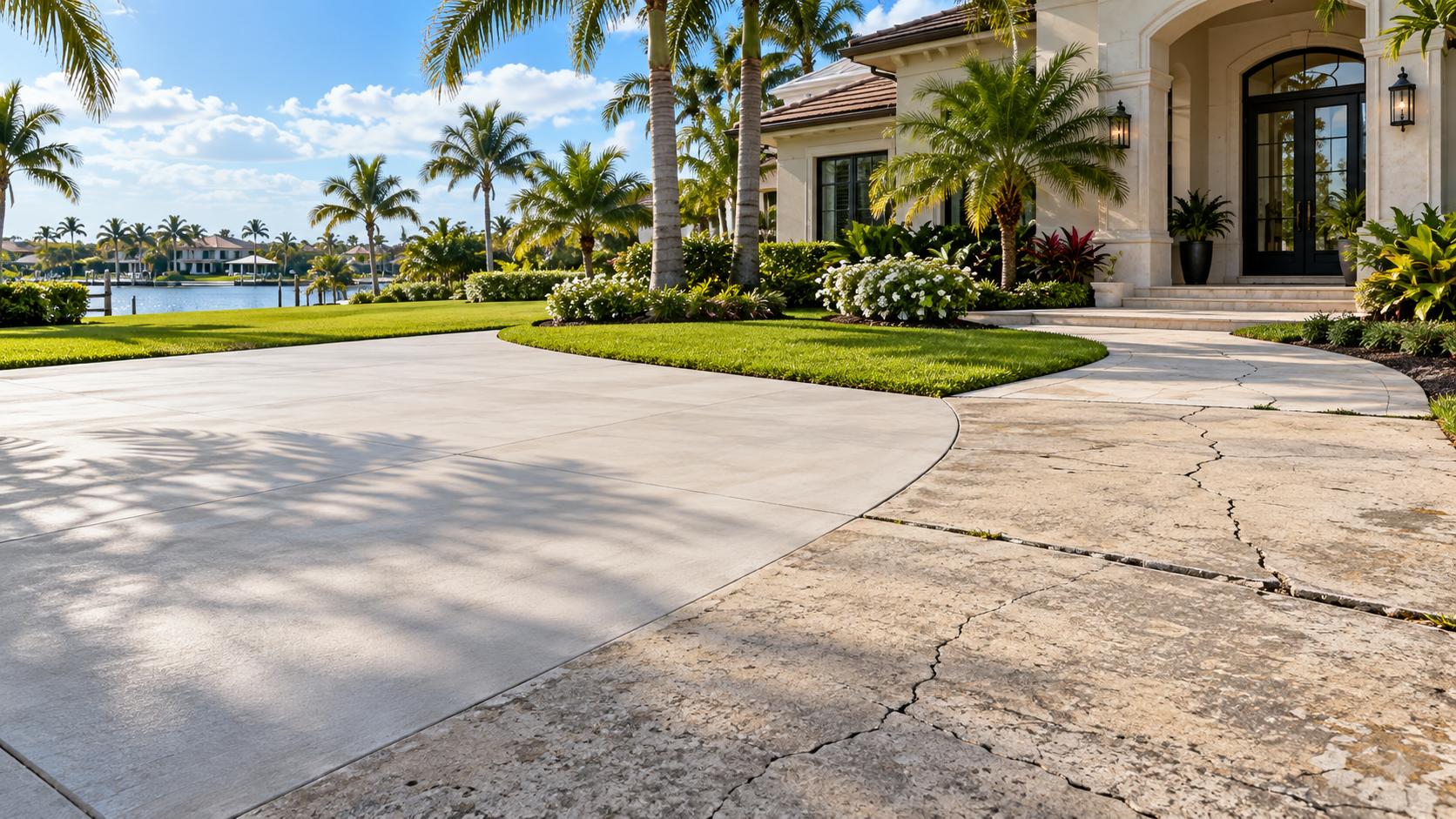
If cracking is accompanied by settlement, recurring movement, widespread deterioration, or failed previous repairs, the next question may be whether the surface should be restored or rebuilt. Compare localized repair, resurfacing, partial replacement, and full replacement based on the condition of the concrete and surrounding site.

Review repair and resurfacing options when the existing concrete may remain suitable for restoration. The service page covers crack treatment, surface deterioration, settlement, drainage, resurfacing, localized removal, and other corrective work.

Use the maintenance page when the surface remains serviceable and the next step involves crack monitoring, joint care, cleaning, drainage awareness, sealing where appropriate, or protecting repaired concrete.

Review how base preparation, grading, concrete thickness, reinforcement where appropriate, jointing, finishing, and curing fit into a new installation. These factors help explain why crack control begins before the concrete is placed.

Concrete cracking can lead to very different project scopes—from localized repair to drainage correction or complete replacement. Use the cost guide to compare how surface condition, demolition, preparation, access, drainage, and the selected corrective approach can affect pricing.

If cracking or deterioration ultimately leads to surface replacement, you may also want to compare poured concrete with a paver-style alternative. Review differences in installation, drainage, maintenance, repairability, appearance, and long-term cost before changing surface systems.
Request a Concrete Estimate for Cracked or Damaged Concrete in Palm Beach County
Understanding why concrete has cracked can help narrow the next step, but the appropriate project scope depends on the actual surface. Crack pattern, settlement, movement, drainage, support conditions, previous repairs, intended use, access, and the condition of the surrounding concrete can all affect the options.
Review concrete services in Boca Raton, concrete services in Boynton Beach, concrete services in Delray Beach, concrete services in Jupiter, concrete services in Lake Worth Beach, concrete services in Palm Beach Gardens, concrete services in Royal Palm Beach, concrete services in Wellington, and concrete services in West Palm Beach, or explore all Palm Beach County concrete service locations.
If you are dealing with cracking, settlement, uneven concrete, surface deterioration, or recurring damage, submit your project details to have the request routed to an independent local concrete contractor or service provider who may contact you about availability, options, pricing factors, and next steps.
Concrete Crack FAQs for Palm Beach County Properties
Is it normal for concrete to crack?
Concrete can develop cracks as it shrinks, changes temperature or moisture content, carries loads, or responds to restraint and support conditions. A crack does not automatically mean the entire surface has failed. Its location, size, movement, surrounding surface condition, drainage, and whether it changes over time provide more useful context.
Why does new concrete sometimes crack?
Early cracking can be associated with plastic shrinkage, moisture loss, curing conditions, restrained shrinkage, jointing, settlement during placement, or other installation and environmental factors. New concrete should be evaluated based on the crack pattern and surrounding condition rather than age alone.
Can poor drainage cause concrete cracking?
Drainage can contribute indirectly. Concentrated runoff, erosion, standing water, washout, or changes in soil and base support can contribute to settlement or movement around a concrete surface. Where cracking occurs together with drainage problems, both conditions should be reviewed.
What does it mean if one side of a crack is higher than the other?
A difference in elevation means the concrete has moved relative to the adjoining section. Settlement, lifting, loss of support, roots, drainage, or another site condition may be involved. The amount of movement and surrounding surface condition should be reviewed before selecting a repair approach.
Why can a repaired crack reopen?
A repair treats the crack itself, but movement can continue if the condition that contributed to the crack remains active. Settlement, shrinkage, restraint, temperature movement, drainage, or support changes can all affect whether a repaired area remains stable.
Does every concrete crack need to be repaired?
Not necessarily. Some fine cracks may be primarily appearance-related, while others deserve closer evaluation because they are changing, associated with movement, allow ongoing deterioration, or affect how the surface functions. The decision should be based on the crack and surrounding conditions together.
Does cracked concrete always need to be replaced?
No. Localized cracking may be suitable for repair when the surrounding surface remains serviceable. Resurfacing, partial replacement, or full replacement may be considered when damage or movement is broader. The appropriate scope depends on the actual surface rather than the presence of a crack alone.
Can sealing stop concrete from cracking?
Sealing can be useful for surface protection where appropriate, but it does not stop active settlement, restrained movement, base problems, or other conditions that are physically moving the concrete. Existing cracks and movement should be evaluated before sealing is treated as the primary solution.